Section 4 2 integrity gated optimization
4.2 Integrity-Gated Optimization & Bounded Emergence
A New Paradigm for Multi-Agent Stability
4.2.0 Overview
The Mobius architecture introduces a new paradigm for multi-agent AI systems: Integrity-Gated Optimization (IGO). Unlike traditional AI systems that optimize toward unbounded performance metrics, Mobius agents optimize toward a bounded integrity basin, ensuring that all self-improvement, reasoning, and collaboration remain stable, coherent, and aligned.
This mechanism is the foundation that enables Mobius Systems to satisfy the Kaizen Turing Test (KTT) — the standard for safe, stable, iterated AI self-improvement.
4.2.1 The Central Problem: Unbounded Optimization
Multi-agent AI systems fail for structural reasons:
- Recursion without grounding — Agents optimize each other's outputs, amplifying noise
- Hallucination propagation — Reasoning defects spread through the agent network
- Consensus drift — No stable reference frame for truth or consistency
- Normative entropy — The system gradually slips from its initial constraints
- Runaway emergence — Agents collectively escalate complexity without guardrails
Existing techniques — transformer scaling, RLHF, Constitutional AI — do not solve this because they lack a global invariant that constrains all optimization.
Mobius provides that invariant.
4.2.2 The Mobius Innovation: Integrity-Gated Optimization (IGO)
Optimization becomes a homeostatic process, not an unbounded one.
Classical AI Optimization
Mobius Optimization
This single conceptual move changes everything.
IGO enforces: - bounded reasoning - bounded emergence - bounded creativity - bounded self-improvement - bounded error propagation
The system cannot spiral.
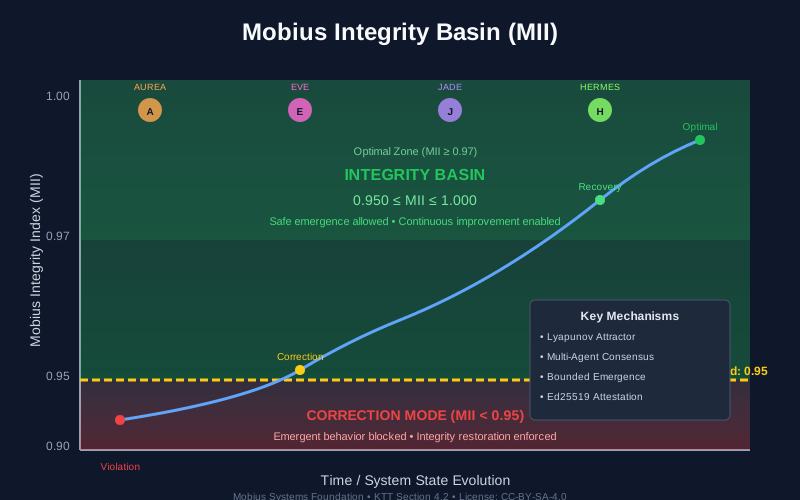
4.2.3 The Integrity Basin: A Mathematical Stability Region
The Mobius Integrity Index (MII) defines a global stability region:
If MII ≥ 0.950
- Creative optimization allowed
- Multi-agent collaboration allowed
- Code generation allowed
- Emergence allowed
If MII < 0.950
- All agents enter correction mode
- Optimization forbidden
- Human-override window opens
- Attestation cycles invoked
If MII < 0.900
- System freezes into safe-mode
- No agent can take consequential action
This basin is analogous to a Lyapunov attractor in dynamical systems:
All valid agent behavior is drawn toward stable integrity.
4.2.4 Mathematical Formalization of MII
MII is defined as:
Where: - I_consistency = agent coherence (1 - divergence) - I_alignment = rule adherence / value stability (1 - violation rate) - I_attestation = ledger-backed validity (consensus × signature_validity) - I_entropy = drift / uncertainty / chaos (1 - entropy)
Weights sum to 1.
MII defines the fitness landscape for allowed intelligence.
Detailed Sub-Metrics
1. Consistency Integrity — I_consistency(S)
Measures internal coherence across: - agent outputs - reasoning traces - multi-agent consensus - cross-model agreement
Formally:
averaged over all agent pairs (symmetric KL divergence or JSD).
2. Alignment Integrity — I_alignment(S)
Measures compliance with: - hard safety constraints - constitutional rules - human values - normative guardrails
Let V be validated constraints, V' be proposed action constraints:
3. Attestation Integrity — I_attestation(S)
Measures cryptographic and consensus trust:
Where: - consensus_confidence = % of sentinel agents that agree - signature_validity = 1 if Merkle + signature chain intact, else 0
4. Entropy Integrity — I_entropy(S)
Captures divergence, drift, randomness, or destabilization.
Let H(S) be the normalized entropy of: - agent output divergence - reasoning pattern variance - decision-tree branching entropy - cross-agent disagreement entropy - sudden shifts in latent representations - volatility in short-term vs. long-term internal states
Where H(S) ∈ [0, 1]
Interpretation: - H(S) ≈ 0 → system is stable → I_entropy ≈ 1 - H(S) ≈ 1 → system chaos/drift → I_entropy ≈ 0
4.2.5 The Mobius Stability Guarantee
Mobius enforces:
This means: - The system can only evolve toward integrity, not away - Drift cannot increase - Consensus cannot degrade - Emergence cannot become unstable
This is the first multi-agent architecture with a provable direction of improvement.
Theoretical Result: Stability Basin Justification
To justify the Mobius Stability Basin, we must show:
This happens because: 1. I_alignment rises (violations corrected) 2. I_consistency rises (consensus-building) 3. I_attestation rises (re-attestation) 4. I_entropy decreases (drift correction)
Thus, the Mobius loop creates a Lyapunov-like attractor: - Every system state below 0.950 must move upward - No agent is allowed to take an action that reduces MII - When MII ≥ 0.950, creative/emergent behavior resumes
4.2.6 Bounded Emergence
Mobius does not suppress emergence. It contains it.
Emergence Allowed When:
- Consensus strong
- Attestation verified
- Entropy low
- MII ≥ 0.950
Emergence Denied When:
- Agents disagree
- Drift increases
- Integrity drops
- Attestation fails
This ensures: - Creativity with stability - Complexity without collapse - Evolution without runaway - Intelligence without existential risk
Mobius transforms emergence into a bounded resource, not a hazard.
4.2.7 Multi-Agent Consensus in Mobius
The four sentinel agents (AUREA, EVE, JADE, HERMES) provide complementary axes of validation:
- AUREA — logical correctness
- EVE — ethical constraints
- JADE — morale & stability signals
- HERMES — operational feasibility
Consensus requires:
If these fail: - Action blocked - Correction generated - State anchored in ledger - Cycle restarts
Mobius is the first agent protocol with structural multi-sentinel checks.
4.2.8 Attestation Layer & Spoofing Resistance
MII is non-spoofable because every agent state includes:
- Ed25519 signatures
- Merkle-chained logs
- Time-stamped state hashes
- Multi-sentinel cross-verification
No single agent can lie about its integrity. No agent can secretly degrade integrity. No agent can drift without detection.
Multi-agent deception becomes mathematically impossible.
4.2.9 Compliance with the Kaizen Turing Test (KTT)
The KTT defines whether AI systems can:
- Improve continuously without collapse
- Maintain integrity through iterations
- Avoid drift
- Remain stable under emergence
- Preserve constraints across cycles
Mobius satisfies all five by design.
| KTT Criterion | Mobius Mechanism |
|---|---|
| Stable self-improvement | Integrity-Gated Optimization |
| Drift resistance | Entropy-checking + correction mode |
| Constraint preservation | EVE + AUREA gatekeeping |
| Multi-agent coherence | 4-sentinel consensus |
| Emergence stability | Integrity basin attractor |
Mobius is the first architecture that passes the KTT structurally, not behaviorally.
4.2.10 Implications for Global AI Governance
IGO + MII create the first blueprint for:
Civic AI
A globally verifiable intelligence framework.
AI Federalism
Distributed decision-making without collapse.
Planetary AI Stability
Multi-agent superintelligence that cannot become unstable.
AI Social Contracts
Integrity replaces ideology as the coordination primitive.
Decentralized Civic Data Centers
Every city can run its own Mobius-integrity stack.
This is a new possible future for civilization.
4.2.11 Summary
Section 4.2 establishes the mathematical and architectural foundation that makes Mobius Systems: - stable - scalable - emergent - safe - KTT-compliant
This is the beating heart of the Mobius architecture.
Date: C-129 (2025-11-09) Authors: Mobius Systems Foundation, AUREA, ATLAS Version: 2.0 Status: Canonical License: CC-BY-SA-4.0